
2. Connection, Balance and Love
2.1 Listening Deeply and Connecting with Others
Where internal worlds collide
Start to connect with the emotions of others – and your own – on a deeper level.
The Practice of Empathy
Listening deeply is more than hearing words—it is the act of being fully present. It means noticing tone, pauses, and what is left unsaid. It requires suspending judgment to allow space for someone’s truth to emerge. Whether in conversation, conflict, or shared silence, deep listening is the bedrock of trust.
The Playlist of the Soul
Imagine that every person has a personal playlist—a soundtrack of their inner world.
But this music is rarely played through clear speakers; it is often distorted by internal static, external noise and filler tracks that don’t serve any real purpose.
Some speak in jazz: improvised and fluid. Others in punk: raw and defiant. Listening means learning their genre.
Why the Playlist Matters
We listen because the music serves a purpose. Sometimes, someone needs a song to meet them exactly where they are — to simply acknowledge the emotion in the moment. Other times, they need the music to gradually take them somewhere more uplifting.
Listening to someone’s story is how you honour that need. You may not love every track they play, but each one reveals something vital. Even the songs you resist have something to teach you. Sit with that discomfort - that is where growth begins.
Listening When It’s Familiar
We don’t all hear the same song in the same way. I loved "Lola" by The Kinks for decades before I ever caught the lyrics. To my young ears, it was just a catchy, upbeat tune. But when I finally listened, the song opened up, revealing a different truth beneath the melody.
We treat familiar people the way we treat familiar songs.
I’ve noticed this in myself.
My own internal playlist has its defaults — tracks I return to when I feel tired, defensive, or sure I’m right. When those songs are on repeat, I can miss what someone else is actually trying to say.
Learning to listen deeply has meant recognising when my own music is too loud — and having the humility to turn it down so I can hear another voice properly.
Listening When It’s Uncomfortable
It is easy to listen when we agree. It is essential to listen when we don’t.
When we hear words we dislike, we aren't just processing sounds; we are practicing a profound act of hospitality. We make room in our hearts for an emotion or perspective that is not our own. Deep listening does not require removing all the noise, only understanding it.
A Note on Masking
Not everyone plays their whole soundtrack out loud. Some people find it easy to share their deeper tracks with those they trust, and others; mask.
For them, 97% of what you hear might be upbeat filler — light, bright, carefully curated. The remaining 3% — the real, raw, honest emotions — may never make it into the public playlist at all. And for a few people, the mask is total: every track sounds cheerful, every lyric polished.
The Villagers express this perfectly in Everything I Am Is Yours:
“I left my demons at the door; why are you opening it for?
I guess they’ll help you understand everything I am.”
For some, unearthing those buried feelings is healing — even cathartic.
For others, opening that door is not liberation; it’s destabilising.
Some wounds need quiet. Some hearts need privacy. Some demons are best left outside so life can move forward.
Deep listening includes recognising this.
It means accepting the soundtrack someone is willing — or able — to play, without prying into tracks they’re not ready to reveal.
When Someone Shares Their Deeper Tracks
When someone trusts you enough to play one of their deeper tracks, be present.
Pause. Listen. Honour the moment. These songs are rarely played; they deserve your full attention.
The Cost of Not Listening
When we don’t communicate openly, we tend to do something else: we replay our own playlist, louder and louder.
We reinforce old patterns, cement our one-sided perspective, and in the process, drown out the melody of the other person.
We can replay our own stories so often in a relationship that we stop hearing the truth, pain, or hope in theirs.
We defend our perspective and, without realising it, deny theirs.
This is how connections fracture.
Your inner world has its own soundtrack. Grace is the patience to question that soundtrack — the maps that guide you — and the courage to let a new song shift your perspective.
The Goal: Connection and Boundaries
Listen with two simultaneous aims:
· To Connect: Understand the speakers truth with a loving heart.
· To Protect: Reapply your boundaries and filters once you’ve heard them fully.
And remember: if a conversation turns hostile or abusive, the deepest listening prioritises self-protection. That is your signal to disengage.
A Note on Responding
How you respond effectively after listening is a complex skill - to get it right each and every time it often requires the work of therapists to teach.
Sometimes that means validation (paraphrasing what you heard). Other times, it requires calm assertion (stating a boundary). And when faced with active hostility, it means choosing strategic disengagement—either a definitive pause for protection or a pre-arranged time-out to return later. Therapists will help work with you to discuss strategies for responding and this extends past the scope of this site
True listening begins and ends with empathy—a continuous effort to get to know their songs, and the courage to play your own.
2.2 Simple pleasures and Gratitude
Finding joy in the simple things, gratitude and sharing with others
For Amelie she finds joy in the small every day moments and her favourite things are skipping stones along the Canal Saint-Martin, along with other delights such as plunging her hands into sacks of grain and cracking crème brûlée with a spoon…
Sometimes the most fun things are those that bring us back to our own childhood … for me my favourite audio blanket of warmness is the Adam Buxton podcast who was not part of my childhood but is a totally lovable manchild … if you’ve not heard it, why not check out his Christmas podcast with his comedy partner Joe Cornish. Alternatively, I place a picnic blanket under a tree and lie facing the branches and the sky above.
Modern media may scratch an itch, but often what we’re starved of most, is connection with other people in real life – try to think of pleasures that don’t involve a screen and aim to share your pleasures with others where opportunities arise.
Once you’ve found what gives you joy, practise gratitude to God, the universe or whatever source you acknowledge for these joyous moments.
The darker the times the greater the need to find the source of light.
When I speak of simple pleasures, I’m not advocating for a retreat into hedonistic bliss.
William Irvine explores the following in A Guide to the Good Life:
“More generally, I saw no need to ponder a philosophy of life. I instead felt comfortable with what is, for almost everyone, the default philosophy of life: to spend one’s days seeking an interesting mix of affluence, social status, and pleasure. My philosophy of life, in other words, was what might charitably be called an enlightened form of hedonism.”
He then goes on to explore different, grander but more grounded philosophies of life to live by.
Note that bathing too long in solitary pleasures can turn you into a prune. Get out before the water turns cold. Reconnect with others. Be human.
Don’t live your life entirely through a screen. The simplest pleasures are those that demand our full presence. They cannot be “multi-tasked”. The crack of crème brûlée, the weight of a smooth stone in your hand – these moments pull us out of the abstract digital world and anchor us firmly in the tangible, sensory one. This is not an escape from life but a return to it.
Take my gym, for example. One of the treadmills has a screen that simulates running through a park. Honestly? It’s pants. Far better to get outside, breathe real air, and run through an actual park. And if it’s cold, dark, or wet – join a running group. Wrap up warm, play music, bring glow-sticks, light bands, torches. Make it fun, make it social.
The Digital Ego Trap
The danger of the digital world goes far beyond simple distraction. It’s evolving into a full-blown crisis of self-worth and genuine human connection.
Social media platforms, in particular, are the ultimate engines of the ego. They encourage us to perform a flawless life – a dazzling performance that completely contradicts our messy, human reality. We are cracked vessels, after all.
This constant, performative exposure depletes your Mental Wellness. It traps you in a brutal cycle of comparison, fostering feelings of deep inadequacy. Suddenly, the true, humble work of Mapping Our Inner World feels tedious and insufficient.
Trading Stillness for Validation
We also have to contend with the attention economy. It’s a business model built on monopolizing your focus, and it’s the exact opposite of the patience and stillness this inner work demands.
It hijacks your free will. Instead of engaging in the deep, non-coercive act of Love, we settle for passive, algorithmic validation.
To truly pursue a life of authenticity, we must recognize a simple truth: Every minute spent feeding the digital ego is a minute taken away from the quiet, difficult work of healing the soul.
2.3. Seven Pillars Of Wellness
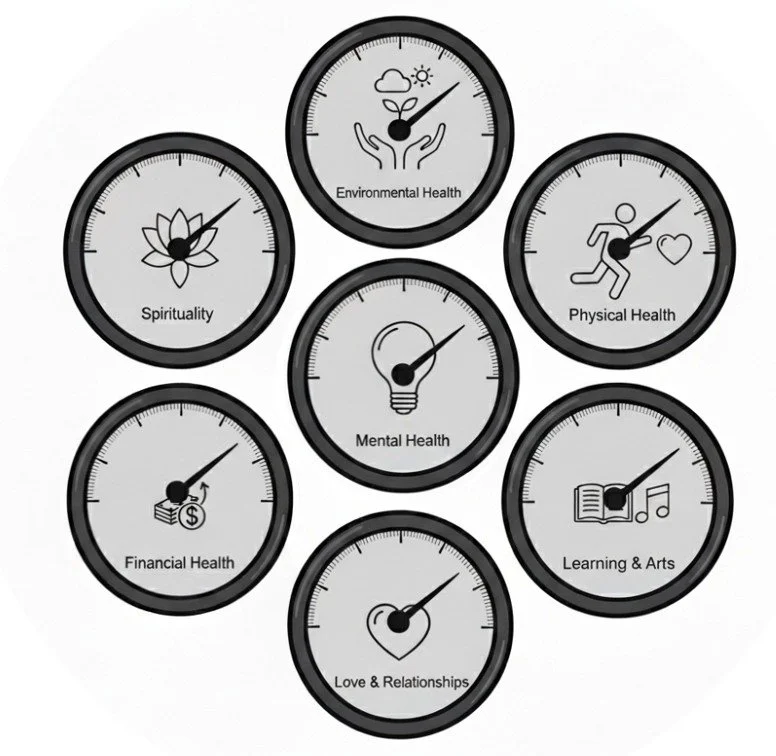
1here are Seven Pillars of wellness, in no particular order:
1. Physical Health
2. Mental Health
3. Environmental – both in the home, local and wider environment
4. Financial and Security – are you managing finances appropriately?
5. Learning, Development and Artistic Expression
6. Love/Relationship: With a Partner, Family, Friend, Local Community and Wider Community
7. Spirituality
Imagine that each of these seven pillars have dials associated with them with numbers 1 to 10 with 10 being maximum. Each one of us can adjust those dials to display where they are now, and where they believe that they need to be to be “fully content” – both of which of course can change over the course of time. Whilst we may wish for all seven dials to be turned up to max, the reality is that we have to accept certain truths for how they are and acknowledge that life doesn’t always work out as planned… sometimes there’s got to be give-and-take, sometimes there’s got to be balance.
Depending on the role of the dice, some people’s dials are stuck. We can wish all the wishes that we want for those dials to move but sometimes they just can’t move, or we can get them to move slightly but at the expense of the other six. Why am I saying this… we all have the power to move at least one of these dials … when certain dials seem immovable, maybe consider that it might be time to tweak one of the other dials and come back to your first dial at a later date.
When considering the dials and pillars why not consider a dial you’ve previously neglected…it might do you the world of good!
Life is the art of balancing these pillars, not conquering them – I would suggest that it’s impossible to get all dials to 10 and the pursuit of perfection is madness. A season of intense learning my lower your physical health dial, and that’s not a failure – it’s a choice. A period of deep love and family care might mean that your “financial” dial rests. This isn’t compromise; it’s the rhythm of a human life. The goal isn’t to have all dials at 10 but to understand the art they make together at any given time.
It should also be added that sometimes you may feel that you’re firing on all cylinders to progress each of the seven as far as you can take them…yet there’s still no perceived improvement – your life still feels dark and anxious…for that all I can say is trust the process – there’s a secret 8th Pillar which is time – sometimes you just have to be a bit patient and let your subconscious play catch-up and let reality play catch-up.
2.4 Defining Love
A personal reflection of love and its meaning
Everyone has their own personal definition of love and challenges often arise when those definitions don’t match-up with others.
…Hey, hold-up…what do you mean that “everyone has their own personal definition of love”?
Fair question. Love itself doesn’t bend to our opinions; it begins with God and flows through us in imperfect streams. We each meet it in a different way and we only ever describe it from where we stand. What we each call 'love' often reflects the limits of our experience. This complexity is compounded by the fact that it’s both a feeling and a choice, an action, a chemistry, and a calling. Each culture, faith and generation wraps it up in different stories.
I’d like to share my definition with you, for what it’s worth. Perhaps, one day, you’ll feel comfortable sharing yours with someone who means a great deal to you, but be patient and kind when you do and avoid arrogance if you feel that yours is better than those close to you for no-one has the authority to declare the ultimate definition of love.
Anyways, for me, love is:
A profound and mature “emotion” characterized by:
· A conscious commitment: A deliberate choice to prioritize the well-being of oneself or another.
· Genuine care: Demonstrated through actions that support the other's growth, autonomy, and happiness, while respecting their boundaries. This is distinct from anxiety or possessiveness.
· Respect: Valuing the other person's individuality and inherent worth.
· Active support: Consistently showing empathy, and reliability through actions, not just words.
Love is distinct from cathexis …. whoa back the truck-up … what’s cathexis you say? It’s just a psychologist’s term for emotional attachment or dependency. It can also be framed as the intense emotional investment of energy.
Cathexis can be seen in both romantic and non-romantic love – but it obviously takes very different forms. For romantic love Cathexis can be a component of initial attraction fuelled by hormones and brain chemicals or a “magical” feeling as some describe, but it does not equate to the enduring and action-oriented nature of true love.
This definition emphasises the active, intentional and respectful nature of love, highlighting its role in fostering well-being and growth and distinguishing it from potentially harmful emotions that may masquerade as love.
Love is not blind loyalty, nor is it servitude. To love someone does not mean tolerating abuse, manipulation or cruelty. Real love honours dignity on both sides – and where dignity is denied, stepping back is not failure – it’s wisdom. Sometimes the most loving act you can make is to draw a boundary. Crucially, this definition of love is inherently non-coercive. It seeks to empower, never to control. Love invites but does not demand. It respects the other’s “no” and much as their “yes”.
In the end, this kind of love is a quiet, persistent commitment to tend to the garden of another’s soul, without needing to own the landscape.